Sensory rooms can comfort children with autism

Calming Sensory Room for Children with Autism

If you have a relationship with a child or children with autism, you may have noticed that they generally struggle to find comfort in the busy world in which we live. Autistic people tend to process sensory information differently than neuro-typical people do, so they likely need more support to thrive in their day-to-day activities.

One great way to support children with autism is to create a sensory room or space for them to spend time in when they feel the need. Such rooms can help kids take a break from the overstimulation they may experience and, instead, be able to decompress in an area that supports their needs.

What is a sensory room?

For children with autism, the world can be an intimidating and anxiety-inducing place. A sensory room is a space that has been designed with this in mind to help calm kids, reducing their anxiety and improving their focus.

A sensory space can be set up as its own room, or occupy just a corner or any part of a bigger room. The important thing is that the area can be separated so that the children using it are able to detach from other things happening in the room.

The benefits of a sensory room

If you have a child with autism in your life, there are many benefits to making space for a specialized sensory room to create a safe and comfortable space for your child. Among the benefits:

At SensoryOne, our strength is more than supplying sensory equipment throughout the United States and Canada. We collaborate and design sensory rooms with clients, ensuring optimal design for environments built with autistic children in mind. Call us with your questions today!

1. Allows therapy to remain consistent

By creating a sensory room at home or at school, you help ensure that your child’s therapy will stay consistent, regardless of where they are. When kids have access to the same soothing methods and occupational therapies in places where they spend most of their time, they will feel the benefits without having to wait for an appointment.

2. Therapy can be personalized

Sensory rooms typically involve a number of different toys, tools and features. This means that one room can be used by several different children, and yet they will all be able to make use of personalized and individualized therapies.

3. Give your child control of their situation

A child with autism may feel powerless in many situations, so having a sensory room to escape to can help to reduce their anxiety and increase their focus.

What to include in your sensory room

Every child is going to have different needs when it comes to finding solace in a sensory room. Some kids will want a quiet and calming space, while others may want a space with things they can touch and feel.

The ideas suggested here are only a starting point. It’s always worthwhile to speak to your child’s therapist to get some ideas as well.

Tactile toys

Tactile items, such as bouncy balls, rubber bands, pop-its and slime toys, encourage kids to touch, play, experiment and learn, making them worthy to include in a sensory room. Some autistic kids love the repetition that these toys offer, as well.

Tools that encourage movement

Rope swings, exercise balls, mini-trampolines, small ball pits, tunnels, ramps and rocking chairs can be great ways for children to get moving. Some autistic children use movement to help work out some of their anxiety.

The right lighting

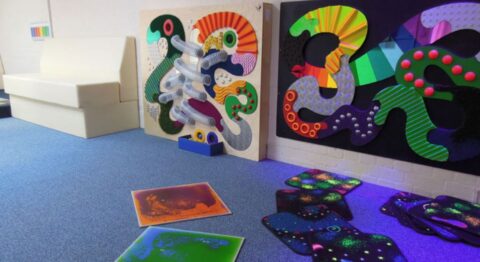
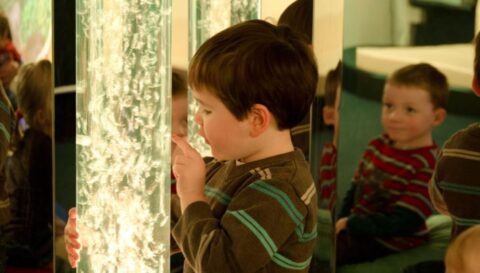
A sensory space should be relaxing and not overly stimulating. Lighting will play a large role in creating such an environment. Include warm, soft lighting that incorporates fiber optic glow kits, curtains, cascades and light panels, to name a few. Of course, Christmas lights, battery-powered candles, lava lights and bubble tubes can change the atmosphere.

Interactive spaces

To help autistic children immerse themselves in tasks, and leave their anxiety at the door, it’s a good idea to include interactive items, such as puzzles, tactile floors and murals, and advanced technological tools, including motion-activated projection systems and immersive virtual reality systems.

The OMI interactive motion-activated projection system offers its Autism Suite package of more than 200 applications specifically targeted to those with Autism Spectrum Disorder. The BroomX MK360 is the only fully mobile, all-in-one VR unit, offering immersive experiences previously unattainable without headsets.

A comfortable crash space

While some children need activities and toys that gently stimulate them, others may need an area where they can relax and decompress. A corner with pillows, cushions, stuffed animals, and weighted blankets can be just the ticket.

Fresh activities

Rather than filling the room with all of the toys and activities that you can think of, consider putting some items aside and then changing it up every few visits. This may not work for all children, but many will thrive on the ability to try something new on a regular basis, rather than face information overload if they see everything all at once each visit.

Sensory rooms will support autistic children in your setting

Whether in a school or other educational setting, or as part of a health care environment, a multi-sensory space may be a missing element in your institution. The positive effects that sensory rooms can have on children with autism are many, and supported by research and experience. Gaining an understanding of how to create the right environment is readily had by contacting multisensory room environment specialists, as well as referring to other institutions that have implemented such spaces.

Virtual tourism: ‘Travel’ that improves life for seniors, staff in long-term care

woman watching broomx projected singing bowls

Many older adults living in long-term care, facing physical, financial or other limitations, can only dream about taking a real trip somewhere.

They can, however, fulfill their wanderlust through “virtual tourism” made possible by state-of-the-art virtual reality technology called the Broomx MK360.

Not only does such VR travel open the world for seniors in long-term care to experience but, in doing so, it also offers a number of benefits that significantly improve the quality of their lives.

And as an added plus, long-term-care staff can also take a much-needed virtual holiday and enjoy the rewards of relaxation away from their stressful jobs.

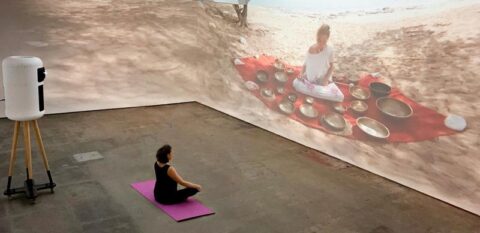
The Broomx MK360, developed in Spain, is now being distributed in North America by Sensory One. It offers a fully immersive experience by projecting a video that stretches across three walls and onto the ceiling, filling a user’s entire field of vision.

The platform comes pre-loaded with 100 different videos that include travel and nature from some of the most beautiful parts of the world, and adventures ranging from guided meditations to fun escapes on roller coasters. A local media company is working on more videos that will be focused on experiences in Canada.

The platform creates these escapes without the need to use headphones. And unlike other machines that require multiple projectors, the Broomx MK360 is the only full mobile, all-in-one unit.

Travel is well-known to provide stress relief at every stage of life. A break from everyday routines, seeing new landscapes, learning about other cultures and just relaxing are some of the restorative benefits of a vacation.

However, as people age, the barriers to getting away increase. Health and other issues can make travel physically difficult and financially impossible.

Studies have shown that living in “collective dwellings,” such as care facilities, is often associated with an increase in depression, loneliness and decreased functioning, adversely affecting health outcomes brought about by aging and living in such facilities.

But now, a feasibility study from Ryerson University has shown that virtual tourism provides many of the same positive outcomes as real travel without residents actually leaving a care facility.

The study’s participants were older adults, with a mean age of 82, living in care facilities in Toronto. They were shown three 10-minute virtual tours every week for six weeks. The study found participants had a decrease in anxiety and an increase in happiness and excitement. They also experienced a significant improvement in social engagement by talking to their families, caregivers and fellow residents about their experiences.

“Qualitative interview data suggest that the virtual tourism program was a positive and enjoyable experience that led to anticipation, social engagement, enjoyment, and escape,” the study’s author reported. “Taken together, these findings suggest that older adults not only enjoyed virtual tourism, but that virtual tourism provided a sense of escape and pause from daily life, as well as an activity to anticipate.”

Care facilities using the Broomx MK360 have found similar results.

“We are surprised by the benefits [of virtual tourism] and to see how much [residents] can remember from their past and relive these experiences. It’s really beautiful,” says an occupational therapist at a care facility in Spain that has been offering virtual tourism to its senior residents through the Broomx MK360.

“The benefits that we’ve seen from virtual therapy are many.”

To learn more about the many rewards of virtual tourism using the Broomx MK360, please click below to watch a demonstration video.

Seeing is believing: Check out this demo of OMI’s Mobii Magic Surface!

If seeing is believing, please tune into the video below to learn all about truly groundbreaking, innovative and inspiring technology called the Mobii Magic Surface, or Mobii for short.

We have put together a complete demonstration of this unique interactive motion-activated projection system, one of several models from OM Interactive (OMI).

The video below shows the many benefits that residents of long-term-care homes derive from interacting with this novel technology and its accompanying applications.

In this video, you you will learn:

  • How easy it is to use this portable system
  • How to make the most of the many different kinds of activities offered
  • How engaged users are, and how rewarding that engagement is for longterm-residents, including those with severe dementia
  • How the Mobii improves intergenerational family visits and staff rapport
  • How empowering it is for users to transform their environments into total multi-sensory experiences!
  • You will also hear testimonials from long-term-care homes whose residents have experienced the many physical, cognitive, emotional and social benefits that this novel technology provides. Please see for yourself to learn the many rewards that the Mobii Magic Surface has to offer!

omiVista Mobii Research Study Finds Huge Benefits for Care Home Residents

omiVista interactive projector for activities in care homes

How Interactive Projection Technology Is Transforming Engagement in Care Homes

If you want to see genuine smiles and meaningful engagement among long-term care and retirement-home residents, few tools are as impactful as interactive projection technology. One standout example is the omiVista Mobii “Magic Surface”, an award-winning interactive projection system designed specifically for inclusive activity, therapy, and engagement.

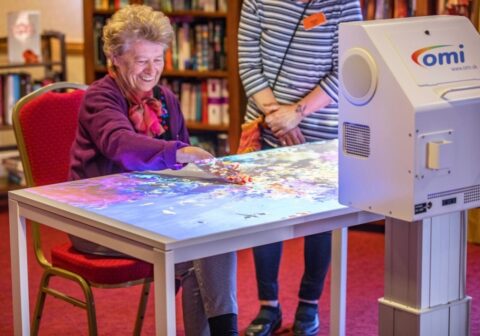
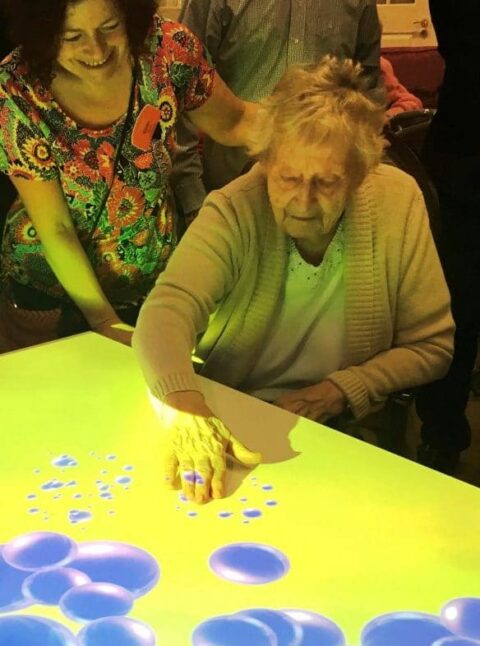
The Mobii is part of a family of pioneering motion-activated projection systems developed by OM Interactive. It projects vibrant images, sounds, and music from a wide range of applications onto floors, tables, trays, and even beds, allowing residents to interact using natural body movement—no controllers, wearables, or complex instructions required.

Designed for Accessibility, Engagement, and Inclusion

Because the Mobii responds to simple movement, it is accessible to individuals with varying physical and cognitive abilities, including those living with dementia, limited mobility, or communication challenges. Activities can be enjoyed independently or in small groups, supporting both therapeutic use and recreational programming.

Research conducted across care homes in the United Kingdom has demonstrated that this type of interactive technology delivers measurable physical, emotional, cognitive, and social benefits for residents.

(To explore the research visually, watch the video below.)

Overview of the OM Interactive Research Study

In the fall of 2018, OM Interactive commissioned Care Research to conduct an extensive study examining the use and impact of the Mobii system across care environments in England.

As part of the research:

  • 10 care homes using the Mobii were visited on site
  • Residents in 7 homes were video-recorded during eight 30-minute sessions
  • Key staff members were interviewed regarding resident responses and outcomes
  • A comprehensive survey was distributed to OM Interactive care customers, with 89 care homes responding

The findings below highlight key outcomes observed during site visits and survey responses, including feedback from staff and family members.

Key Research Findings

Regular and sustained use

  • 85% of respondents used their Mobii at least weekly
  • 39% reported daily use, indicating strong adoption and long-term value

Encouraging Movement for Physical and Emotional Health

The Mobii provided residents with a purposeful and enjoyable way to move, encouraging participation without the pressure of traditional exercise.

  • Over 90% of respondents reported positive impacts on physical ability, participation, and movement
  • Activities promoted flexibility, coordination, and upper-body engagement in a low-stress environment

Supporting Emotional Well-Being

The system consistently created a positive and uplifting atmosphere.

  • Smiles, laughter, and visible enjoyment were frequently observed
  • 75% of respondents felt the Mobii helped engage residents who were previously withdrawn or disengaged

Reminiscence and Nostalgia: Reconnecting With Memory

Interactive visuals and themed activities often sparked storytelling and memory recall.

  • Residents who began sessions quietly often became animated and conversational
  • 92% of participants engaged in reminiscence during sessions, sharing personal memories and experiences

Enhancing Social Interaction and Reducing Loneliness

The Mobii encouraged shared experiences that brought residents together.

  • Singing, laughter, and group participation were commonly observed
  • 80% of staff agreed the system increased meaningful social interaction and quality time with peers, staff, and visiting family members

Rich Sensory Engagement and Calming Experiences

Residents responded strongly to the system’s multisensory design.

  • High-contrast visuals, sweeping motions, and interactive “painting” were particularly engaging
  • Calming music content was noted as especially helpful for residents experiencing anxiety or distress
  • 96% of respondents said they would recommend the Mobii to other care homes

Reported Benefits Across Care Homes and Healthcare Settings

Care homes, centres, and hospitals using interactive floor and table projection systems reported:

  • Increased socialization and willingness to communicate
  • Shared enjoyment and spontaneous laughter
  • Improved flexibility, coordination, and upper-body movement
  • Moments of lucidity and emotional brightness
  • Stronger relationships between residents and staff
  • Improved emotional stability and overall well-being
  • Greater motivation to stand, stretch, and participate
  • More opportunities to share personal stories
  • Staff gaining deeper insight into the person behind the diagnosis
  • Families enjoying meaningful shared activities without conversational pressure
  • Flexibility to be calming or stimulating, depending on content selection
  • Independent engagement opportunities that do not rely on constant staff direction
  • Inclusive use on floors, tables, or at bedside
  • Increased spontaneous singing and vocalization

To explore the full research study, click here.
For inquiries in Canada and the United States, contact SensoryOne to learn how interactive projection systems can support engagement, wellness, and quality of life in your care environment.

Meet the BroomX MK Player360: Latest advance in VR technology offers benefits to special-needs users

Closing in on a year that has largely confined us to home, wannabe globetrotters are increasingly fantasizing about the sights, sounds and places they long to visit.

However, even when real travel is possible again, there are many people with physical, financial or other limitations who will find taking a trip difficult, if not impossible.

These range from older adults, including those with dementia, who live in long-term-care facilities to people with special needs, such as some with Autism Spectrum Disorder (ASD).

For these people, virtual travel can be the next best thing to being there. Credit the latest advances in virtual reality technology, including the BroomX MK360, newly available in North America.
Fully immersive VR experience: no headset required!

This device, originating in Spain, creates a fully immersive experience without the need for VR headsets.

And while other similar technology requires multiple projectors, the BroomX is the only fully mobile, all-in-one unit. It projects a video that stretches across three walls and onto the ceiling, creating a 4-D experience within a user’s entire field of vision.

Imagine, for instance, sitting amid a pod of dolphins watching them swim all around you, splashing and creating waves, and listening to them whistle and click.

Or how about virtually forest bathing — lying in a bed of autumn leaves in the woods, with rays of sun shining down through the trees, birds chirping in the background. These are among the experiences offered by more than 100 different 360-degree videos available to project through the BroomX.

With no need for headsets, users of the BroomX have less chance of experiencing eye strain or “cybersickness,” a form of motion sickness in response to virtual environments. Many people also find headsets uncomfortable to wear. People with dementia or ASD might resist wearing them.

Improved cognitive function, memory stimulation rewards

VR technology like the BroomX offers many rewards for users such as older adults and people with ASD, ranging from feelings of calm and relaxation to improved cognitive function, memory stimulation and a reduction in acute and chronic pain.

Recent research using the BroomX studied the impact of immersive technologies on people with Alzheimer’s disease and moderate to severe dementia living in long-term-care facilities.

In this study, 325 participants from three long-term-care homes enjoyed VR experiences such as being transported to a lush green park to see the cherry blossoms in bloom, being taken to the heart of a bustling city, or finding themselves surrounded by dairy cows in a farmer’s field.

These experiences were not only entertaining but engaging cognitively, emotionally and socially. The research found that residents who used the BroomX were relatively calmer, happier, and more relaxed afterwards. Time with the BroomX projections also lifted moods,stimulated memory, improved appetites and eating among underweight residents, and led to increased conversations and better sleep among all participants.

Study participants reduce psychotropic medications

One of the most notable findings of the study, known as The Albert Project and conducted by Primacare Living Solutions with partners including the Centre for Aging and Brain Health Innovation (CABHI), was a 30-per-cent reduction in the use of psychotropic medications to treat participants’ responsive behaviours.
To learn more about the results found in the Albert Project study, please watch this video. VR tools help make those with ASD more comfortable

VR technology has also proven helpful in dealing with the sensory, attention, behaviour, and communication challenges faced by people with ASD, to help them better connect with the people and world around them.

For instance, therapists have used virtual reality exposure therapy to help people become more comfortable in some situations, such as being outdoors. Immersing them first in a virtual park makes it less stressful for them to make the transition to a real park. Similarly, VR technology has been used to help combat phobias.

The BroomX can be used to project 360-degree videos other than the ones provided with the device, for instance, home videos or ones taken at a particular event that might have special meaning to those watching.

The BroomX is sold exclusively in North America by Sensory One, a division of Xlent Care Products Inc.

Sensory One distributes innovative, award-winning and inspiring sensory products and multi-sensory environments customized to the individual needs of users.

Please contact us to learn more.