Meet the BroomX MK Player360: Latest advance in VR technology offers benefits to special-needs users

Closing in on a year that has largely confined us to home, wannabe globetrotters are increasingly fantasizing about the sights, sounds and places they long to visit.

However, even when real travel is possible again, there are many people with physical, financial or other limitations who will find taking a trip difficult, if not impossible.

These range from older adults, including those with dementia, who live in long-term-care facilities to people with special needs, such as some with Autism Spectrum Disorder (ASD).

For these people, virtual travel can be the next best thing to being there. Credit the latest advances in virtual reality technology, including the BroomX MK360, newly available in North America.
Fully immersive VR experience: no headset required!

This device, originating in Spain, creates a fully immersive experience without the need for VR headsets.

And while other similar technology requires multiple projectors, the BroomX is the only fully mobile, all-in-one unit. It projects a video that stretches across three walls and onto the ceiling, creating a 4-D experience within a user’s entire field of vision.

Imagine, for instance, sitting amid a pod of dolphins watching them swim all around you, splashing and creating waves, and listening to them whistle and click.

Or how about virtually forest bathing — lying in a bed of autumn leaves in the woods, with rays of sun shining down through the trees, birds chirping in the background. These are among the experiences offered by more than 100 different 360-degree videos available to project through the BroomX.

With no need for headsets, users of the BroomX have less chance of experiencing eye strain or “cybersickness,” a form of motion sickness in response to virtual environments. Many people also find headsets uncomfortable to wear. People with dementia or ASD might resist wearing them.

Improved cognitive function, memory stimulation rewards

VR technology like the BroomX offers many rewards for users such as older adults and people with ASD, ranging from feelings of calm and relaxation to improved cognitive function, memory stimulation and a reduction in acute and chronic pain.

Recent research using the BroomX studied the impact of immersive technologies on people with Alzheimer’s disease and moderate to severe dementia living in long-term-care facilities.

In this study, 325 participants from three long-term-care homes enjoyed VR experiences such as being transported to a lush green park to see the cherry blossoms in bloom, being taken to the heart of a bustling city, or finding themselves surrounded by dairy cows in a farmer’s field.

These experiences were not only entertaining but engaging cognitively, emotionally and socially. The research found that residents who used the BroomX were relatively calmer, happier, and more relaxed afterwards. Time with the BroomX projections also lifted moods,stimulated memory, improved appetites and eating among underweight residents, and led to increased conversations and better sleep among all participants.

Study participants reduce psychotropic medications

One of the most notable findings of the study, known as The Albert Project and conducted by Primacare Living Solutions with partners including the Centre for Aging and Brain Health Innovation (CABHI), was a 30-per-cent reduction in the use of psychotropic medications to treat participants’ responsive behaviours.
To learn more about the results found in the Albert Project study, please watch this video. VR tools help make those with ASD more comfortable

VR technology has also proven helpful in dealing with the sensory, attention, behaviour, and communication challenges faced by people with ASD, to help them better connect with the people and world around them.

For instance, therapists have used virtual reality exposure therapy to help people become more comfortable in some situations, such as being outdoors. Immersing them first in a virtual park makes it less stressful for them to make the transition to a real park. Similarly, VR technology has been used to help combat phobias.

The BroomX can be used to project 360-degree videos other than the ones provided with the device, for instance, home videos or ones taken at a particular event that might have special meaning to those watching.

The BroomX is sold exclusively in North America by Sensory One, a division of Xlent Care Products Inc.

Sensory One distributes innovative, award-winning and inspiring sensory products and multi-sensory environments customized to the individual needs of users.

Please contact us to learn more.

Mobii Magic Surface brings joy to Lanark Heights Long Term Care

Sensory Room Interactive Projector Seniors Care

As published in Canadian Health Technology, Sept 2020.

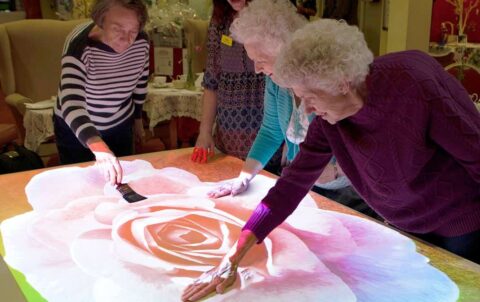
(Photo does not depict residents of Lanark Heights Long Term Care but seniors at another unidentified facility)

KITCHENER, ONT. – A grey-haired woman slowly shuffles her walker toward a huddle of giggling residents. Her face is blank when she notices that her peers are sweeping their arms across a large black and white projection of spring flowers on a tabletop.

Magically, the flowers are turning vibrant colors with each pass of an elderly hand.

Within a minute of observation the woman joins in and begins moving her arms to “paint” flowers too. She smiles as she reaches and waves her arms across the tabletop. Her normally stiff limbs relax and her body flows as she enjoys the group activity.

A scene like this no longer surprises Hildy Nickel, administrator of the Lanark Heights Long Term Care facility in Kitchener, Ont. In fact, she has seen it enacted multiple times since her facility introduced the Mobii Magic Surface to its 160 residents two years ago.

“The Mobii is fun for our residents, and it involves more movement than most of our other activity offerings,” says Nickel, who likes to stay current with the latest technology. “We offer exercise programs, coloring, puzzles and many other activities. But the Mobii is something different that always creates spontaneous smiles and laughter.”

The Mobii is a small, self-contained portable projector that houses a wealth of rich and stimulating activities for older adults, including those with dementia. The motion-activated, interactive tool uses images, games, quizzes, color and music to evoke memories, stimulate conversation and encourage physical activity.

The technology makes it enjoyable and easy for people to move their bodies and to interact with the world around them. It also allows them to have some control over their environment.

Designed by sensory technology company OM Interactive, and winner in the Outstanding Dementia Product category in the U.K.’s Dementia Care Awards, the Mobii can be easily wheeled directly to groups of residents in communal areas or to individual bed-bound residents. Images can be projected onto a tabletop or onto the floor for larger groups and games.

The floor projection is ideal for those who are able to ambulate. For example, they can walk or wheel across a virtual nature trail, scattering leaves along the way. Non-ambulatory residents can enjoy the same experience using their feet from a seated position.

Its versatility is appreciated by staff members. They can adjust the volume, control the object speed, and easily create custom content with photos of family members or special events.

Residents can push tiny seashells, resting in shallow tropical water, into a pile. They can watch the water ripple and listen to the sounds of the sea.

Or toss a beanbag into a puddle. Watch and hear the splashes.

They might wipe away the image of an old-fashioned candy shop with a hand or baton to reveal childhood sweets, or use a feather duster to wipe away steam and reveal a train with actual family members peering out the windows.

They can tap on moving eggs and crack them open, using hands, feet, a cane or a walker.

Care homes report that while the physical activity and powerful visuals help improve their residents’ physical fitness, they also reduce apathy, stress and anxiety.

With the Mobii, these visuals can include greenery, birds, trees and gardens. Research shows that nature experiences – even virtual versions – can boost emotional well-being and awaken feelings of happiness and peace.

For family members, interacting with the Mobii helps remove the pressure of struggling to make conversation with an elderly loved one. Family visits are more exciting for everyone when they know that they can play together with the Mobii.

A 2018 research study of 89 care homes in the U.K. found that 96 percent of respondents would recommend the Mobii. Additional findings showed that:

  • 90 percent of respondents felt the Mobii had a positive impact on their residents’ physical ability, participation and movements; and
  • 75 percent felt the Mobii had helped their most withdrawn residents

General survey comments were equally enthusiastic: “Our residents love it!” “Their lives are more fulfilled.” “They don’t notice they’re being physically active.” “It brings residents out of themselves.” “It’s great to see them interacting with each other.”

There is a current move away from the idea that long-term care homes are solely medical treatment centres.

“Stimulating and engaging all older adults, especially those living with dementia, with meaningful person-centered activities is so important in care homes, centres and hospital settings,” said Gwen Rose, vice-president of Toronto-based Sensory One, and North American distributor of the Mobii Magic Surface and other innovative and unique sensory products.

“There’s a strong move toward an emotion- based model of care, which focuses on the idea that a long-term care home is a resident’s home,” said Rose, who practised as a physiotherapist in long-term care for over 14 years. “With this model, there’s an added focus, beyond providing basic care, of helping people to live well by giving them a sense of belonging and opportunities for vibrancy. The Mobii stimulates physical, cognitive and social engagement and contributes to emotional well-being.”

At Lanark, staff members particularly appreciate the Mobii’s portability and versatility.

“If a resident is having a tough day, they can easily take the Mobii directly to that person and then have dozens of activity options to choose from,” says Nickel.

It helps staff members more easily make a connection with residents by stimulating conversation, activity and fond memories. For withdrawn residents, it encourages them to interact and communicate with others.

And at Lanark, it is not just the residents who are benefiting from the technology.

“We’ve included the Mobii in family council meetings, a staff holiday luncheon, and several other staff events,” Nickel says.

NAPA Benefit Dinner – 24th September 2019

On 24th September OM Interactive were delighted to sponsor the NAPA Drinks Reception at Birmingham Metropole hotel to honour the legacy of Sylvie Silver, who has spent her career championing the use of arts, crafts, music and creativity in care homes and day centres nationally.

Our team enjoyed catching up with colleagues from Sunrise Senior Living, Hallmark Care and NAPA Year of the Arts award winners, Fir Villa (a care home with highly creative staff who own one of our Mobii systems). The dinner was followed with a poignant speech by Des Kelly OBE and emotional words from Sylvie herself. We were formally introduced to Hilary Woodhead who has stepped into Sylvie’s little (but difficult to fill!) shoes at NAPA and the evening ended with a richly deserved standing ovation.

As recognised NAPA suppliers we are proud to carry their logo, recognising the incredible effort of Activity Coordinators and staff all over the country who dedicate so much time to improving quality of life every day for those in their care. We wish Sylvie a happy retirement and Hilary every success in her new role.

BBC1 – OMi Ambassador Noah on #DIYSOS 20th Anniversary

On 6th September 2019 we were delighted to see our very own Ambassador, Noah Wall, back on our screens as part of the DIYSOS 20th Anniversary Special on BBC1.

The programme celebrated the amazing impact the DIYSOS home make-over has had on the Wall family in the five years since it was filmed, particularly the incredible advances Noah has made, due in part to the specialist equipment he was gifted.  Born with spina bifida and only 2% brain Noah was not expected to survive birth let alone develop into the bright capable boy we know and love today.

Read More >

Embracing Interactive Technology at Andrew Smith House

Recently Stocks Hall Andrew Smith House welcomed OM Interactive who came to demonstrate their motion-activated projection system.

The ground-breaking Mobii system is the first truly mobile motion-activated table-projection system that can easily be moved to those who need it. It can be adjusted to a different height/size surface at the touch of a button making it an invaluable flexible intervention in all care settings.

Here’s Leslie Ann, who lives at Andrew Smith House, photographed here with her husband Barney using the OM Interactive table together.  They thoroughly enjoyed the demonstration, discovering meaningful activities to enjoy together.  Leslie Ann was fascinated with the coral reef and took on the challenge of the cake making exercise.

Read More >